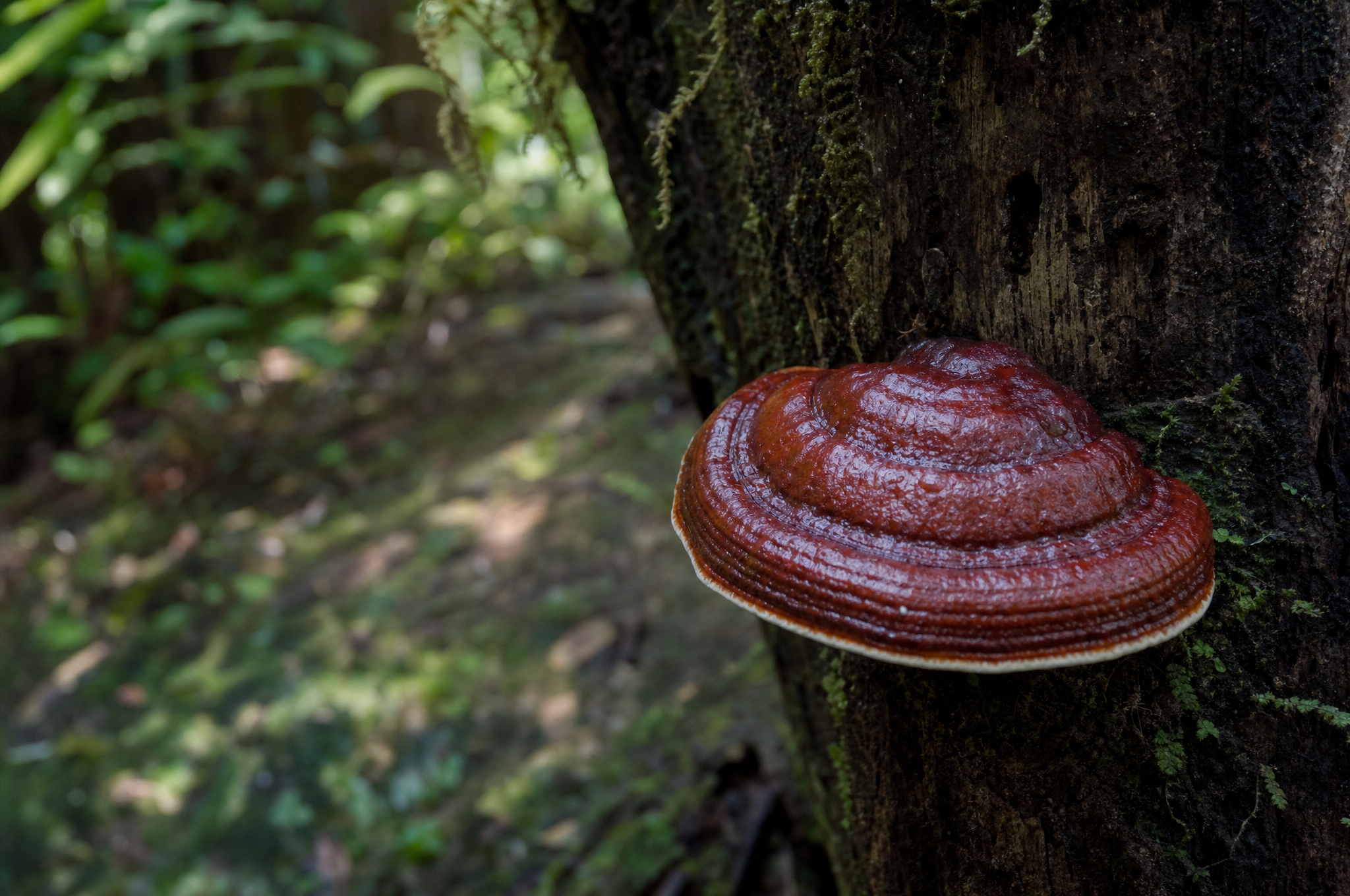
No mushroom carries the weight of cultural history quite like Reishi. Known as lingzhi (灵芝) in Chinese — literally "spiritual mushroom" or "divine fungus" — it has been revered in East Asian traditions for over two millennia. The Chinese poet and pharmacologist Li Shizhen catalogued it in his monumental 1578 work Bencao Gangmu, and its image appears in imperial art, medicinal texts, and cultural symbolism across centuries.
This article traces Reishi from its roots in traditional Chinese medicine to its current status as a subject of modern pharmacological research. The journey reveals not just the story of a mushroom, but the evolving relationship between traditional knowledge and scientific inquiry.
The Imperial Tonic
In the hierarchy of traditional Chinese medicine, Reishi occupied a singular position. The Shennong Ben Cao Jing (Divine Farmer's Materia Medica), compiled around 2,000 years ago, classified Reishi among the highest-grade medicines — substances believed to promote longevity, preserve vitality, and harmonize the body's energies. It was said to be non-toxic even with long-term use, a rare classification for any medicinal substance.
The text described Reishi as effective for conditions including chest congestion, liver complaints, and what we might today interpret as anxiety or insomnia. But its most celebrated role was as a general tonic — something taken not to cure a specific ailment, but to maintain wellness and extend life. This concept of the tonic — a substance that supports rather than intervenes — is central to East Asian medical philosophy.
"Long-term taking of Reishi will lighten the body and prevent aging, lengthen the years, and act like a supernatural being." — from the Shennong Ben Cao Jing, translated. This is traditional belief, not medical claim.
In imperial China, wild Reishi was rare and highly prized. Its distinctive reddish-brown, lacquered appearance made it visually striking, and finding one was considered an auspicious event. Emperors sent search parties into the mountains, and the fungus was presented as tribute. It became a symbol of longevity, spiritual potency, and divine favor — appearing in paintings, sculptures, and even on official robes.
The Species Question
One challenge in discussing Reishi's history is taxonomic. "Reishi" and "lingzhi" are common names, not scientific ones. The name refers to several species within the genus Ganoderma:
- Ganoderma lucidum — the European/temperate species most commonly referenced in Western literature
- Ganoderma lingzhi — the species most commonly cultivated and used in China (formally distinguished from G. lucidum in 2012)
- Ganoderma sinense — a darker species also used in Chinese medicine, sometimes called "black Reishi"
- Ganoderma applanatum and others — related bracket fungi with different properties
The formal distinction between G. lucidum and G. lingzhi is relatively recent. For centuries, these fungi were grouped under common names. Modern research has had to account for this — studies that use "Ganoderma lucidum" may be working with any of several species, complicating comparisons.
When a supplement label says "Reishi," it rarely specifies the species. This matters because different Ganoderma species produce different compound profiles. A study on G. lucidum may not apply to the G. lingzhi in your supplement — and vice versa.
Key Compounds: Triterpenes and Polysaccharides
Modern research on Reishi has focused on two major compound classes:
Ganoderma Triterpenes
Reishi produces over 150 identified triterpene compounds — bitter-tasting molecules that give the mushroom its characteristic flavor and its reputation as an acquired taste. These triterpenes, including ganoderic acids and lucidenic acids, have been studied for:
- Anti-inflammatory effects in cell cultures
- Potential hepatoprotective (liver-protective) activity in animal models
- Cytotoxic effects on certain cancer cell lines in vitro
- Modest blood pressure effects in some animal studies
Polysaccharides
Like many medicinal mushrooms, Reishi contains beta-glucan polysaccharides — complex sugars that interact with the immune system. Reishi polysaccharides (sometimes called ganoderans) have been studied for:
- Immunomodulatory effects — enhancing or balancing immune responses
- Potential anti-tumor activity in preclinical models
- Blood glucose regulation in some animal studies
These are laboratory findings, not clinical proof. The leap from "shows activity in a cell culture" to "produces a therapeutic effect in a human" is enormous and often fails. For more on how to evaluate this research, see our article on Turkey Tail and immune research, which covers similar territory with one of the best-studied medicinal fungi.
The Transition to Modern Science
Reishi entered modern scientific investigation in the mid-20th century, as Japanese and Chinese researchers began applying analytical chemistry to traditional remedies. The discovery of triterpenes in the 1980s and the identification of specific polysaccharides generated significant academic interest. Research has continued, though much of it remains preclinical.
What makes Reishi scientifically interesting is not that it is a miracle cure — it is not. It is that a mushroom revered for centuries for promoting calm, longevity, and general wellness turns out to contain compounds with measurable biological activity relevant to inflammation, immune function, and cellular health. This convergence of traditional knowledge and modern science is genuinely worth investigating — while maintaining critical perspective.
Traditional Uses in Context
In traditional Chinese medicine, Reishi was used for:
- Calming the spirit (an shen) — addressing anxiety, restlessness, and insomnia
- Supporting respiratory health — particularly coughs and asthma
- Supporting liver function
- Promoting general vitality and longevity
These uses are embedded in a holistic medical system with its own diagnostic framework, which does not map directly onto Western disease categories. A TCM practitioner would not prescribe Reishi in isolation — it would be part of a personalized formula tailored to an individual's constitution and condition.
This context is often lost in supplement marketing, which strips Reishi from its traditional framework and presents it as a standalone "miracle mushroom." The result is a product that is neither faithful to tradition nor validated by modern clinical research.
What Modern Research Suggests (and Doesn't)
| Area | Traditional Use | Research Status |
|---|---|---|
| Calm / Anxiety | Used to "calm the spirit" | Limited human data; some small trials suggest mild anxiolytic effect |
| Immune function | Used as general tonic | Polysaccharides show immunomodulatory effects in vitro; human trials small and mixed |
| Sleep | Used for insomnia | Traditional use strong; modern evidence limited. See our Reishi and sleep article |
| Cancer | Not traditionally used for cancer | Preclinical activity; no proven anti-cancer benefit in humans |
Cultural Respect and Scientific Honesty
One of the challenges in writing about Reishi is honoring its cultural significance without overclaiming its medical value. Traditional Chinese medicine is a sophisticated, evolving system — not a collection of folk remedies. Reishi's role within it reflects centuries of clinical observation and philosophical framework.
But traditional use, however rich, is not the same as clinical proof. The honest position is to respect both: to acknowledge the depth of traditional knowledge while applying the rigor of modern science to evaluate it. Reishi deserves both respect and critical inquiry.
Continue reading: Reishi and Sleep: What Traditional Use and Modern Studies Suggest