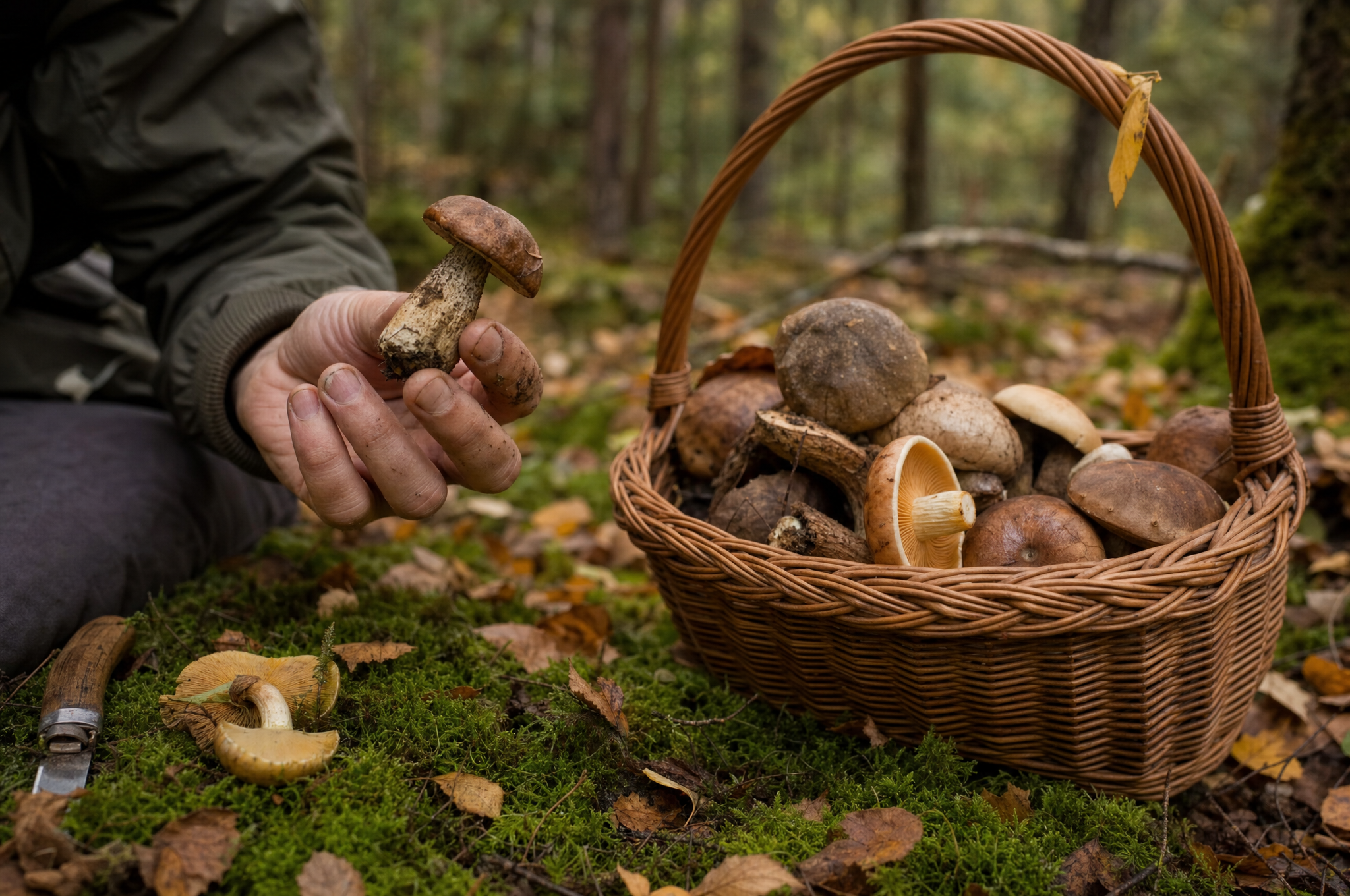
This article provides a framework for learning, not a field guide. It cannot teach you to identify mushrooms. No article, app, or book can replace in-person mentorship. Eating a misidentified wild mushroom can cause permanent organ damage or death. If you are a beginner, treat every mushroom as potentially lethal until an expert tells you otherwise.
Why This Framework Exists
Most mushroom foraging accidents don't happen because people are reckless. They happen because people are confident without being competent. The Dunning-Kruger effect is a real danger in mycology: a little knowledge can feel like enough knowledge, and the gap between the two can be fatal.
This framework is designed to slow you down. It is deliberately conservative. The goal is not to help you identify mushrooms faster — it is to help you build the habits and respect that make identification safe.
Principle 1: Identification Means Species-Level, Every Time
"It looks like a chanterelle" is not identification. Identification means you have determined, with reasonable certainty, the exact species of a mushroom — not just its genus, not just that it resembles something edible. And you have done so using multiple identifying features, not just color or shape.
Proper identification considers:
- Cap morphology: Shape, size, color, texture, surface features
- Spore-bearing surface: Gills, pores, teeth, or smooth — and their attachment, spacing, and color
- Stem features: Presence or absence of a ring (annulus), volva (cup at the base), thickness, texture
- Spore print color: A critical diagnostic feature — place the cap gill-side down on paper overnight
- Flesh characteristics: Color changes on cutting, bruising reactions, texture
- Habitat and substrate: What is it growing on? Wood, soil, moss? What trees are nearby?
- Season: Mushrooms fruit on predictable seasonal schedules
- Sometimes: microscopic features — spore shape and size, cystidia, hyphal structure
No single feature is sufficient. A mushroom that looks like a safe species in every visible respect could still differ in a single critical detail — a detail that separates edible from deadly.
Principle 2: Never Eat on First Encounter
Even when you believe you have positively identified a mushroom, do not eat it the first time you find it. This is a foundational rule practiced by experienced foragers. Here's why:
- Your identification may be wrong, and eating a small amount is less dangerous than eating a large amount
- You may have an individual allergic reaction, even to a correctly identified edible species
- Some people are sensitive to species that are safe for most people
- It gives you time to verify your identification with multiple sources and, ideally, an expert
The first time you eat any wild mushroom species, eat a small amount, wait 24 hours, and monitor for any adverse reaction. This is not paranoia — it is standard foraging practice.
Principle 3: Start With the "Foolproof Four"
Experienced foragers often recommend that beginners start with species that have no dangerous look-alikes. These are sometimes called the "foolproof" edibles, though this term should be used with caution — no mushroom is truly foolproof if you skip the identification process. Still, these species are the safest entry points:
| Species | Why It's Beginner-Safe | Still Watch For |
|---|---|---|
| Chicken of the Woods (Laetiporus) | Bright orange shelf fungus with yellow pores — very distinctive | Some Laetiporus species grow on conifers and can cause GI upset; only eat those on hardwoods |
| Giant Puffball (Calvatia gigantea) | Large white ball — must be cut open to confirm pure white interior | Can be confused with immature Amanita eggs (deadly). Always cut in half vertically |
| Chanterelle (Cantharellus) | Distinctive vase shape with false gills (ridges), apricot scent | Jack O'Lantern (Omphalotus) is toxic and orange — but has true gills and grows on wood|
| Morel (Morchella) | Honeycomb cap, hollow when cut lengthwise | False morels (Gyromitra) are toxic and not hollow — always cut lengthwise to verify |
Even for these species, invest in a good regional field guide and learn the specific look-alikes for your area. The species above are common in North America and Europe, but regional variations matter.
Principle 4: Learn From People, Not Just Books
The single most valuable thing a beginning forager can do is join a local mycological society. Most regions have one, and they typically host forays (group mushroom walks) led by experienced identifiers. On a foray, you will:
- Learn to identify mushrooms in their actual habitat, not just in photographs
- See look-alike species side by side
- Develop pattern recognition that takes years to build alone
- Meet mentors who can review your identifications
- Learn local ecology, seasons, and species distribution
Books and apps are tools, but they cannot replace this experience. An app that identifies a mushroom from a photo is not a reliable tool for edibility decisions — it can be wrong, and being wrong can be fatal.
"When in doubt, throw it out." — The most important rule in foraging. There is no mushroom so delicious that it is worth risking your life.
Principle 5: Understand the Deadly Species in Your Area
Before you ever eat a wild mushroom, you should be able to recognize the deadly species that grow in your region. In North America, these include:
- Death Cap (Amanita phalloides) — pale greenish cap, white gills, volva at base. Responsible for most mushroom foraging deaths worldwide. Looks deceptively ordinary.
- Destroying Angel (Amanita species) — pure white, elegant, and deadly. Contains the same amatoxins as the Death Cap.
- Autumn Skullcap (Galerina marginata) — small brown mushroom that can be confused with honey mushrooms or psilocybin species. Contains amatoxins.
- False Morel (Gyromitra esculenta) — wrinkled, brain-like cap. Contains gyromitrin, which is metabolized to rocket fuel hydrazine. Can be fatal.
Amatoxin poisoning is particularly insidious because symptoms may not appear for 6–24 hours after ingestion. By the time symptoms manifest, the toxins have already caused severe liver and kidney damage. There is no antidote. Treatment is supportive and may require liver transplant.
If you suspect you or someone else has eaten a poisonous mushroom, call poison control immediately (1-800-222-1222 in the US) or go to an emergency room. Save a specimen of the mushroom for identification. Do not wait for symptoms — early intervention is critical.
Principle 6: Keep Records
Experienced foragers keep detailed records of what they find, where, and when. A foraging journal helps you:
- Track seasonal patterns and return to productive locations
- Build confidence in identifications through repetition
- Note environmental conditions (rainfall, temperature, tree associations)
- Document species you have not yet identified, for later research
Photograph mushrooms in situ before picking them — capture the cap, gills, stem, base, and habitat. These photos are valuable for verification and learning.
Principle 7: Respect the Ecosystem
Foraging is not just about what you take — it's about what you leave behind. Cutting vs. pulling mushrooms, not overharvesting, respecting private property and protected areas, and minimizing habitat disturbance are all part of ethical foraging. Read more in our article on sustainable foraging ethics.
The Long Path
Mycology is a lifelong study. The most experienced foragers are still learning, still cautious, and still humble about what they don't know. The goal is not to become an expert quickly — it is to build the knowledge, habits, and respect that allow you to forage safely for a lifetime.
Start slow. Start with the easy species. Start with a mentor. And remember: the forest will be there next season. There is no rush, and there is no room for overconfidence.
For more on the ethical dimensions of foraging, see Foraging Ethics: Sustainable Mushroom Picking Practices. For mushroom identification in a broader context, visit our Fungi Guide.